Article
Why you don’t need a new CRM
Monday 12 January 2026
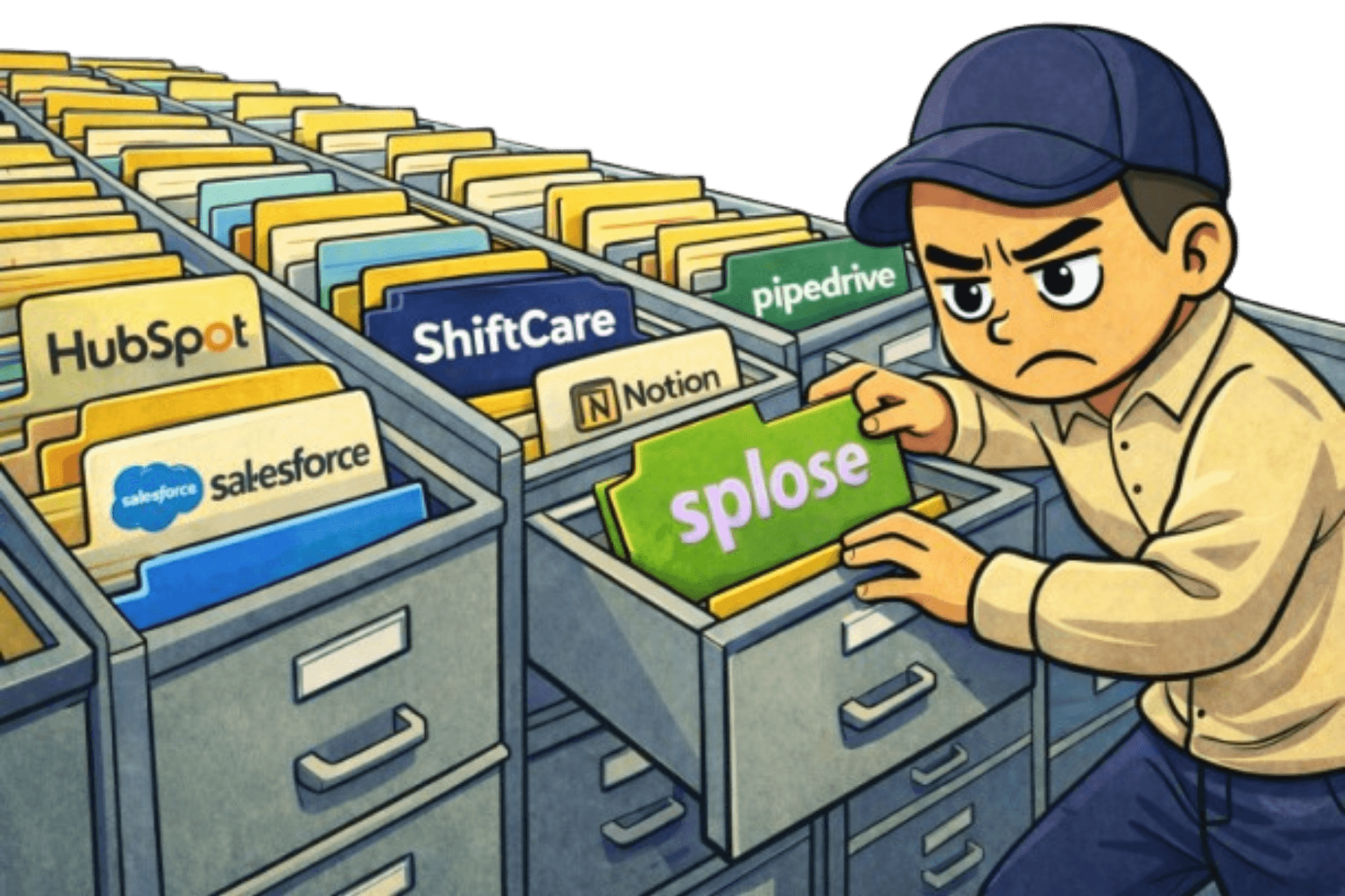
"Why can I just find the perfect system for my specific issue?
Surely with the millions of software out there, there should be ONE golden tool!"
— said every person who works on a business
I just wanted to check something…
Have you ever felt that small, persistent itch at the back of your mind when a new piece of software pops up on your iPad or phone?
You weren’t looking for it.
It just decided to show up on your Instagram or Facebook or Pinterest feed, just suggesting it could solve a problem you’ve been facing for a while now.
It could have been about the overwhelming amount of admin work.
Tasks like incident reporting, endless back-and-forth of spreadsheets, forms, and duplicated data, etc.
So you click through and…
The interface looks amazing! Clean. Thoughtful. It has features you recognise and others you didn’t even know you wanted.
There’s AI involved, of course. Testimonials. Logos you trust. A sense that someone, somewhere, finally gets what you’re dealing with.
You might even start the free trial.
You enter a few details, click around, and imagine how it could fit into your week. And for a brief moment, there’s a sense of relief.
A feeling that maybe this is the thing that finally makes the day-to-day tasks easier.
If you’re someone who’s constantly looking for something more productive, more efficient, and more tailored to your exact situation, then that reaction makes complete sense. (And honestly, I would do the same as well.)
When work keeps piling up, and meetings become more and more stressful, searching for a better system feels like the responsible thing to do.
It feels logical.
What rarely gets said, though, is that this feeling, the new shiny tool that seems to be so different, is exactly what keeps people stuck in the same cycle.
Because the uncomfortable truth is that there isn’t a perfect tool.
Not because software companies aren’t trying or because you haven’t looked hard enough.
There are plenty of tools that get close. Some that do many things well. Some are definitely better than others at specific tasks.
But none of them are built specifically for YOU🫵.
I mean, how could they?
A piece of software doesn’t sit in your meetings.
It doesn’t see where things break down on a busy Tuesday afternoon.
It doesn’t know which steps your team avoids because they’re frustrating or time-consuming.
That’s not the same as being tailored to your reality.
And this is why, even when a tool feels good, there’s always something slightly off. A missing feature. A workaround. A small irritation that slowly turns into another itch. The moment one problem is managed, another becomes visible, and before long you’re back where you started, looking again.
Most people assume this means they haven’t found the right tool yet.
In reality, it means they’re trying to solve the wrong problem.
The problem isn’t that your tools aren’t powerful enough. It’s that the pain you’re experiencing was never caused by the tools in the first place.
For instance, admin overload doesn’t usually come from bad software. It comes from the way work flows or, specifically, the way it doesn't flow between systems.
It comes from processes that evolved under pressure, with quick fixes layered on top of quick fixes. Extra steps added “just in case”.
Over time, those decisions compound, and so what you end up with isn’t a system so much as a patchwork of different tools.
When a new platform is introduced into that environment, it doesn’t remove the friction. It absorbs it. The same work still needs to be done; it just moved apartments.
This is why switching systems often feels slower, at least at first. Even when the software is objectively better, there’s always disruption.
Teams need time to learn new interfaces, rebuild habits, and translate old ways of working into new ones.
During that adjustment period, admin doesn’t disappear.
And so the search continues.
What’s rarely considered is a different approach altogether.
So instead ask, “What work are we doing that shouldn’t exist at all?”
Because if the pain disappears, the urge to keep searching disappears too.
Most organisations already have tools that work reasonably well on their own. Tools like Gmail, Xero, Google Sheets, Splose and other care platforms. The real friction lives in the gaps between them. The copying and pasting. The re-entering of information. The chasing of approvals. The constant context-switching, and so on, and so on.
This is where systems thinking, and now more than ever, automation and AI actually make a difference.
Not as another layer of software, but more like a background employee who's really quiet, almost silent, but does the specific tedious tasks before anyone notices.
When those gaps are addressed, something really interesting happens.
The tools you already use start to feel more functional, reliable and, honestly, even a bit more boring.
But it's better than a mountain of tasks you don't want to do, right?
Because what most people want isn't a shiny new dashboard or the latest feature.
It's just for the core issue to stop and for their team to have more likeable and focused work without getting interrupted and for it to last.
If you’re chasing features, there will always be another CRM.
If you’re trying to make the problem disappear, the answer is rarely a new tool, and it's just patching up what's broken, even if it's in the backend.
P.S. the “perfect” system usually feels boring because it doesn’t need your constant attention.